William Harper Irwin family in 1900's

William Harper Irwin family in 1900's
William Harper Irwin family in 1900's Back row L-R:Harry, Nora, William, Front row: L-R: Leona, Livonia, William, Ansel
Showing posts with label William Grahams. Show all posts

Thursday, June 28, 2012

William and Nancy Irwin parents of James Irwin, born in Lack Twp., Cumberland County, PA on 16 Oct. 1758 and died on 10 February 1847 in Butler County, Ohio.


William and Nancy Irwin parents of James Irwin, born in Lack Twp., Cumberland County, PA on 16 Oct. 1758 and died on February 1847 in Butler County, Ohio.

James Irwin - Revolutionary War Veteran, served as private in
1777 under Captain William Graham and General Potters Brigade of the 4th Battalion, 2nd Company of Milford Township, Cumberland County, PA militia on the frontier against the British.
1778 under Captain David Boal or Boles of the 7th Battalion, 2nd Company of Milford Township, Cumberland County, PA militia against the Indians at “Standing Stone Valley“. 
1780 under Captain David Boal of the 7th Battalion, 2nd Company of Milford Township, Cumberland County, PA militia against the Indians at Kishacoquillas Valley. 

James Irwin marries Nancy (Agnes)  on February 2, 1786 in Cumberland County, PA.

James Irwin is Presbyterian.

James and Nancy Irwin’s children:
Ann Irwin born November 1, 1786, Milford Twp., Mifflin County, PA
John Irwin born February 18, 1788, Milford Twp., Mifflin County, PA
Mary Irwin born April 9, 1789, Milford Twp., Mifflin County, PA
Jane Irwin born May 19, 1791, Milford Twp., Mifflin County, PA
James Irwin born March 12,1793, Milford Twp., Mifflin County, PA
Robert Irwin born March 19, 1795, Milford Twp., Mifflin County, PA
William Irwin born October 19, 1797, Milford Twp., Mifflin County, PA

James Irwin family relocate to Warren County, Ohio in 1798 from Pennsylvania. 

U.S., Sons of the American Revolution Membership Applications, 1889-1970 Record for Robert L Owen under James Irwin, his great-grandfather.


http://search.ancestry.com/Browse/view.aspx?dbid=2204&path=067.391&sid=&gskw=Robert+L+Owen

http://search.ancestry.com/Browse/view.aspx?dbid=2204&path=067.392&sid=&gskw=Robert+L+Owen

http://search.ancestry.com/Browse/view.aspx?dbid=2204&path=067.393&sid=&gskw=Robert+L+Owen

Robert L. Owens, the son of Margaret Ann Irwin, grandson of Robert Irwin and Lydia Cox, great-grandson of James and Nancy Irwin. Robert list James Irwin’s parents as William and Nancy Irwin.  This is the first indication or clear evidence that we have regarding the parents of James Irwin born 1758 in Cumberland County, Pennsylvania and died 1847 in Butler County, Pennsylvania. 

U.S., Sons of the American Revolution Membership Applications, 1889-1970 Record for Robert L Owen pg 1

U.S., Sons of the American Revolution Membership Applications, 1889-1970 for Robert L. Owens pg2

U.S., Sons of the American Revolution Membership Applications, 1889-1970 for Robert L Owens pg3

Monday, March 12, 2012

James Irwin may have been from Milford Township, Cumberland County, PA?


http://www.portal.state.pa.us/portal/server.pt/community/revolutionary_war_militia_overview/4125/cumberland_co__revolutionary_war_militia/435888

Revolutionary War Militia Battalions and Companies, Arranged by County
 
  1777 - 4th BATTALION 1780 - 7th BATTALION
  • Col. Samuel Lyon
  • Lt. Col. James Purdy
Township (if known) 1777 1780
Milford Township
  • 1st Company
  • Capt. John Williams
  • 8th Company?
  • Capt. James Harrell
Greenwood Township
  • 2nd Company
  • Capt. John Foutz
  • 2nd Company
  • Capt. David Boal (Bole)
Milford Township
  • 3rd Company
  • Capt. John Elliott
  • 6th Company?
  • Capt. Daniel McClelland
Greenwood Township
  • 4th Company
  • Capt. Philip Mathews
  • 3rd Company
  • Capt. Philip Mathews
Fermanagh Township
  • 5th Company
  • Capt. John Hamilton
  • 7th Company
  • Capt. John Taylor
Lack Township
  • 6th Company
  • Capt. Jonathan Robison
  • 4th Company
  • Capt. William Campbell
Lack Township
  • 7th Company
  • Capt. James McConnell
  • 5th Company
  • Capt. Andrew Farrier
Fermanagh
  • 8th Company
  • Capt. Robert McTeer
  • 1st Company
  • Capt. Hugh McAlister

http://www.digitalarchives.state.pa.us/archive.asp?view=ArchiveIndexes&ArchiveID=13&FL=I

Revolutionary War Military Abstract Card File Indexes

A B C D E F G H I J K L M N O P Q R S T U V W X Y Z
 

I Indexes

Iago, John - Imlay, John
Imlay, John - Ingram, Thos.
Ingram, Thos. - Irvin, Andw.
Irvin, Christey - Irwin, Christm.
Irwin, Christopher - Irwin, Wm.
Irwin, Wm. - Ishmal, Thomas
Isinghour, Hichl. - Izard, Jonathan

Graham, Andrew - Graham, James
Graham, James - Graham, Tedekiah
Graham, Thomas - Gramling, Adam

Blough, Abraham - Boatman, Claudius

Porter, Wm. - Potter, Wm.
Potter, William - Poultney, John

http://imageservice.ancestry.com/iexec/image.x?f=getimage&dbid=2204&iid=32596_242202-00369&mac=00634671092608480919HADsTalLtHw=&vx=0&vy=0&vw=3802&vh=3101&zp=75&qf=mc&rc=&sh=0&sw=0

This is portion of Son of American Revolution Application of William Henry Graham, great-great-grandson of Captain William Graham.  

Captain William Graham Military Record from his widow's pension application

As you notice Captain William Graham military service was in Cumberland County, PA in the 4th Battalion, 1st Company in July 1777 to May 14, 1778.  According to Pennsylvania Archives – “Revolutionary War Militia Battalions and Companies, Arranged by County” he would be from Milford Township in Cumberland County, Pennsylvania

William Graham 4th Battalion 1st Company

Captain William Graham military record from “Revolutionary War Military Abstract Card File Indexes” you will notice that this confirms that he was in the Cumberland County Pennsylvania Militia 4th Battalion 1st Company.  This is during the  same time period that James Irwin enlisted into Cumberland County Pennsylvania Militia under Captain William Grahams as a private. 

General James Potter return of Penns Militia at Camp Whitemarsh, Phila County, PA on Nov 24, 1777

As you will notice in the above military record of General James Potter Brigade that he is returning the Pennsylvania Militia from Camp White Marsh in Philadelphia County, Pennsylvania on November 24, 1777 where their 2 month enlisted had expired.  (Enlisted Autumn of 1777).  Our James Irwin was in that brigade and apparently served in Camp White Marsh. 

Below is background and movement to battle at Camp White Marsh during the time that James Irwin was stationed there.

After their October 4, 1777, defeat at the Battle of Germantown, Washington's army retreated along Skippack Pike to Pawling's Mill, beyond the Perkiomen Creek, where they remained encamped until October 8. They then marched east on Skippack Pike, turned left on Forty-Foot Road (present-day Old Forty-Foot Road), and marched to Sumneytown Pike, where they camped on the property of Frederick Wampole near Kulpsville in Towamencin Township.[6]While there, Brig. Gen. Francis Nash died of wounds incurred at Germantown and was buried in the Mennonite Meeting Cemetery. Washington remained at Towamencin for one week, gathering supplies and waiting to see if Howe would move against him.[7] On October 16, Washington moved his forces to Methacton Hill in Worcester Township. After learning of Howe's withdrawal from Germantown to Philadelphia, Washington moved his army to Whitpain, 5 miles (8.0 km) closer to Philadelphia, on October 20.[8] On October 29, Washington's army numbered 8,313 Continentals and 2,717 militia, although the terms of enlistment of many soldiers from Maryland and Virginia were due to expire.[9] With his ranks reinforced, Washington dispatched a brigade to assist with the defense of Forts Mifflin and Mercer, on the Delaware River.[8] On November 2, at the recommendation of his council of war, Washington marched his forces to White Marsh, approximately 13 miles (21 km) northwest of Philadelphia.[10] At White Marsh, the army began to build redoubts and defensive works.[10]

After the surrender of British Lt. Gen. John Burgoyne after the Battles of Saratoga, Washington began drawing troops from the north, including the 1,200 men of Varnum's Rhode Island brigade, and about 1,000 more men from various Pennsylvania, Maryland and Virginia units.[11] Maj. Gen. Horatio Gates sent Col. Daniel Morgan's rifle corps, and the brigades of Paterson and Glover.[9] With these additional forces, and the pending onset of winter, Washington had to face the problem of supplying his army.[10] A quarter of the troops were barefooted, and there were very few blankets or warm clothing. Washington became so desperate that he even offered a reward of $10 to the person who could supply the "best substitute for shoes, made of raw hides".[9] Morale was so low and desertion so common that Washington offered a pardon on October 24 to all deserters who returned by January 1.[10]Washington's loss of Philadelphia and inactivity brought criticism from Congress, who pressured him to attack the city. He therefore called a council of war on November 24 which voted against an attack 11 to 4.[12] Nonetheless, Washington rode out the next day to view the British defenses, which turned to be stronger than he had expected.[13]

Capt. John Montresor was responsible for establishing the defenses around British-occupied Philadelphia.

On October 19, Howe withdrew the British forces from Germantown and focused on the defense of Philadelphia. British military engineer Capt. John Montresor supervised the building of a series of fourteen formidable redoubts that began at Upper Ferry, along the Schuylkill River, and extended eastward to the shores of the Delaware River, just north of Philadelphia.[14][15] Howe took advantage of his time in Philadelphia to raise additional forces from the loyalist population in the region. Newly-promoted Maj. John Graves Simcoe reinforced his unit, the Queen's Rangers, which had lost over a quarter of its men at the Battle of Brandywine.[16] William Allen, Jr., the son of notable loyalist William Allen, raised the 1st Battalion of Pennsylvania Loyalists, and was made its lieutenant colonel.[17] Loyalist James Chalmers raised the 1st Battalion of Maryland Loyalists, and was given its command.[18] Recruitment also took place among the city's Irish Catholic population, with the formation of the Irish Catholic Volunteers, and in the counties immediately surrounding Philadelphia.[19] In mid-November, the fall of Forts Mifflin and Mercer effectively ended American control of the Delaware River, and much-needed supplies began arriving at the city's docks, along with 2,000 additional British soldiers.[20]

The weeks with two major armies sitting within miles of each other were not without conflict, and a petite guerre[21] ensued in the no man's land between White Marsh and Northern Liberties. Minor skirmishes between light troops increased in intensity throughout November, with almost daily losses being incurred by both the British and the Americans.[22] In retaliation, on November 22, Howe ordered his troops to set fire to several large country houses in the Germantown area, including Fair Hill, a mansion and country estate that had previously belonged to John Dickinson.[23] Eleven houses in all were burned to the ground, and residents of Philadelphia climbed onto rooftops and church steeples to watch the spectacle.[23] Just one day earlier, crowds had gathered to watch the burning of Commodore John Hazelwood's Pennsylvania Navy in the Delaware.[24] On the same morning the mansions were burned, an earthquake struck Philadelphia, and was felt as far away as Lancaster.[25] On November 27, an aurora borealis lit up the night skies.[26] The two events caused quite a stir among both the residents of Philadelphia and the troops, British and American alike, who took them as an ominous sign of things to come.[27]

By early December, Howe decided, despite having written to Colonial Secretary Lord George Germain requesting to be relieved of his command, that he was in a position to make one last attempt to destroy Washington's army before the onset of winter, and he began preparations for an attack on the American forces.[28] Washington's intelligence network in Philadelphia, led by Maj. John Clark, became aware of British plans to surprise the Americans. According to a historically unsubstantiated story,[29]Howe's movements were revealed to the Americans by a Quaker woman named Lydia Darrah,[30] who overheard British officers quartered in her house discussing Howe's plan, and crossed the British lines to deliver this information to Col. Elias Boudinotof the Continental Army, who was at the Rising Sun Tavern between Germantown and Northern Liberties, attempting to secure provisions.[31] Boudinot immediately relayed this information to Washington,[31] and the Continental Army was ready when Howe, with a force of approximately 10,000 men, marched out of Philadelphia just prior to midnight on December 4.[32] The advance column, led by Lt. Gen. Lord Cornwallis, headed up Germantown Pike. A second column, led by Lt. Gen. von Knyphausen, marched toward the American left.[32]

Below is James Irwin Cumberland County, Pennsylvania Militia Records from “Revolutionary War Military Abstract Card File Indexes”.  You will notice that on July 14, 1778 James Irwin was delinquent in serving in the militia per order of the council.  He was fined 100 pounds.  He was assigned from Milford Township in Cumberland County to 4th Battalion 1st Company under the command of Captain Philip Matthies. 

James Irwin Cumberland County, PA 4th Battalion 1st Company Capt. Philip Matthies

On March 12, 1782 James Irwin was called from Milford Township to serve in 7th Battalion 8th Company of Cumberland County, Pennsylvania Militia by order of the council. It appears that he served during this time. 

James Irwin Cumberland County, PA 7th Battalion 8th Company called March 12, 1782 by order of the Council

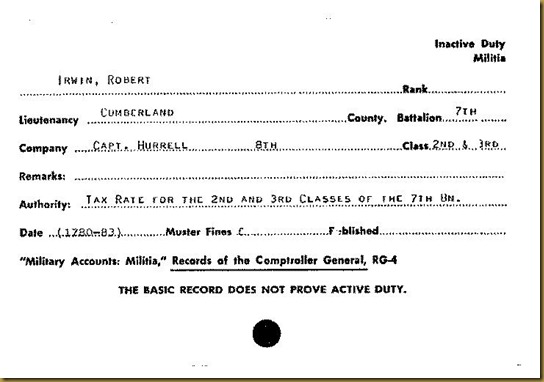
Below is a Revolutionary War Military Abstract Cards of Irwin’s living in Cumberland County, Pennsylvania during the Revolutionary War. 

Revolutionary War Militia Battalions and Companies, Arranged by County
  1777 - 4th BATTALION 1780 - 7th BATTALION
  • Col. Samuel Lyon
  • Lt. Col. James Purdy
Township (if known) 1777 1780
Milford Township
  • 1st Company
  • Capt. John Williams
  • 8th Company?
  • Capt. James Harrell
Milford Township
  • 3rd Company
  • Capt. John Elliott
  • 6th Company?
  • Capt. Daniel McClelland

4th Battalion 1st Company – Milford Township

Christm Irwin Cumberland County, PA 4 Battalion 1st Company with Captain John Elliot by Order of the Council July 14, 1778

James Irwin Cumberland County, PA 4th Battalion 1st Company Capt. Philip Matthies

William Graham 4th Battalion 1st Company

4th Battalion 3rd Company – Milford Township

John Irwin Cumberland County, PA 4th Battalion 3rd Company called by order of Council July 14, 1778 Captain John Elliot

7th Battalion 8th Company – Milford Township

Christopher Irwin Cumberland County, PA 7th Battalion 8th Company called to perform a tour of duty June 1781 remitted at appeal

Robert Irwin Cumberland County, PA 7th Battalion 8th Company Captain Hurrell 1780-83Robert Irwin Cumberland County, PA 7th Battalion 8th Company Called March 12 1782 by order of the councilJames Irwin Cumberland County, PA 7th Battalion 8th Company called March 12, 1782 by order of the Council

7th Battalion 6th Company – Milford Township

Andrew Irwin Cumberland County, PA 7th Battalion 6th Company called January 1778 by order of the Council Captain Frederic Tailor


Revolutionary War Militia Battalions and Companies, Arranged by County
  1777 - 4th BATTALION 1780 - 7th BATTALION
  • Col. Samuel Lyon
  • Lt. Col. James Purdy
Township (if known) 1777 1780
Lack Township
  • 7th Company
  • Capt. James McConnell
  • 5th Company
  • Capt. Andrew Farrier

4th Battalion 7th Company – Lack Township

Thomas Irwin Cumberland County, PA 4th Battalion 7th Company on Delinquent List Nov. 19, 1782

David Boal in Cumberland County, PA Militia 7th Battalion 4th Company

David Boal in Cumberland County, PA Militia served 1 half months in 1778

David Boal in Cumberland County, PA Militia 1785

James Irwin first enlisted in Fall 1777 and served two months near Valley Forge, Pennsylvania


James Irwin first enlisted in Fall 1777 Cumberland County, Pennsylvania –  he served 2 months under Captain William Graham in General Potter Brigade near Valley Forge,  Pennsylvania.  It appears that his tour of duty was over in October or November 1777.    
Valley Forge, Pennsylvania in 1777 
What some people might not know is that this piece of land, which played a significant part in the struggle for independence, did not see any fighting.  Valley Forge received its name from the iron forge that was constructed along Valley Creek, next to current PA 252, in the 1740s.  A sawmill and grist mill had been built by the time of the encampment, making the area an important supply base for the American fighters.
In the midst of the American Revolution (1775-1783), in 1777, the British devised a plan to capture Philadelphia which had become the de-facto capital of the 13 colonies.  Sir William Howe brought nearly 17,000 British troops into the colonies by having them land at the head of the Chesapeake Bay in Maryland.  General George Washington marched his 12,000-man Continental Army from New Jersey to meet this invasion.  Although their British counterparts won two key battles, as well as Philadelphia, the Americans gained confidence in their fighting abilities and realized they only needed a little more training to reach their full potential.
As winter approached in 1777, Washington had to find a place for his army to make camp.  In doing so, he had to balance the wishes of the Continental Congress to organize a winter campaign to push the British out of Philadelphia with the needs of his weary and poorly supplied men.  By mid-December, General Washington picked the area in Valley Forge to make camp just 20 miles northwest of Philadelphia.  The army would be close enough to maintain pressure on the British forces, yet far away enough to prevent a surprise attack.  One reason that Washington choose the section of land was because it offered natural defenses against such an attack.  He knew the British would not come from the north or the east, because of the Schuylkill River, and not from the west because of Mount Misery.  The only way they could attack Valley Forge would be from the south which would mean suicide for the British forces as the area of the park sits higher than the land to its south and at that time it was open farm land.
On December 19, 1777, when Washington's poorly fed, ill-equipped army, weary from long marches, staggered into Valley Forge, winds blew as the 12,000 Continentals prepared for winter's fury. Only about 1/3 of them had shoes, and many of their feet were leaving bloody footprints from the marching. Grounds for brigade encampments were selected, and defense lines were planned and begun. Though construction of more than a thousand huts provided shelter, it did little to offset the critical shortages that continually plagued the army.
The men were under cover within six weeks. The first properly constructed hut appeared in three days. One other hut, which required 80 logs, and whose timber had to be collected from miles away, went up in one week with the use of only one axe. These huts provided sufficient protection from the moderately cold, but mainly wet and damp conditions of the mild, but typical Pennsylvania winter of 1777–1778. Snow was limited, and small in amounts. Alternating freezing and melting of snow and ice made it impossible to keep dry and allowed for disease to fester.
Soldiers received inadequate supplies of meat and bread, some getting their only nourishment from "fire cake," a tasteless mixture of flour and water. However, due to the talents of Baker General Christopher Ludwig, the men at Valley Forge more often than not received fresh baked bread, about one pound daily. So severe were conditions at times that Washington despaired "that unless some great and capital change suddenly takes place ... this Army must inevitably ... Starve, dissolve, or disperse, in order to obtain subsistence in the best manner they can." Animals fared no better. General Henry Knox, Washington's Chief of Artillery, wrote that hundreds of horses either starved to death or died of exhaustion. So, Washington appointed Nathanael Greene as Quartermaster General, who is in charge of the supplies. Greene found caches of food and clothing and hauled them here for the troops and horses.
Clothing, too, was wholly inadequate. Many wounded soldiers from previous battles died from exposure. Long marches had destroyed shoes. Blankets were scarce. Tattered garments were seldom replaced. At one point these shortages caused nearly 4,000 men to be listed as unfit for duty.
Undernourished and poorly clothed, living in crowded, damp quarters, the army was ravaged by sickness and disease. Typhoid, jaundice, dysentery, and pneumonia were among the many diseases that killed 2,500 men that winter. Although Washington repeatedly petitioned for relief, the Continental Congress was unable to provide it, and the soldiers continued to suffer. Women, relatives of enlisted men, alleviated some of the suffering by providing valuable services such as laundry and nursing that the army desperately needed.
Upgrading military efficiency, morale, and discipline were as vital to the army's well-being as was its source of supply. The army had been handicapped in battle because unit training was administered from a variety of field manuals, making coordinated battle movements awkward and difficult. The soldiers were trained, but not uniformly. The task of developing and carrying out an effective training program fell to Baron Friedrich von Steuben. This skilled Prussian drill master, recently arrived from Europe, tirelessly drilled the soldiers.
A group of people called Regimental Camp Followers also helped increase the morale of the soldiers and provided necessary support to the men. Camp Followers at Valley Forge consisted of the families, wives, children, mothers, and sisters of the soldiers.
These camp followers often served as laundresses, cleaning and mending the uniforms of the soldiers. Washington understood a soldier would die quickly from disease if his uniform was dirty and threadbare. These women and children also provided the emotional support to a soldier, allowing them to remain at camp and continue on training and soldiering during the winter months. These women gained half the rations of soldiers, half the wages of a soldier as well as a half pension after the war—if they had done enough work. Children would receive quarter rations if enough work was done.
Women were relegated to the back of the column when marching and were forbidden to ride on wagons. Camp followers faced the issues of disease along with the soldiers. While excellent scavengers, some women lost their lives on the battlefield trying to obtain goods from wounded or dead soldiers. At Valley Forge women averaged 1 to every 44 men, adding up to around 500 women.
Soon word of the British departure from Philadelphia brought a frenzied activity to the ranks of the Continental Army. On June 19, 1778, six months after its arrival, the army marched away from Valley Forge in pursuit of the British, who were moving toward New York. The war would last for another five years, but Washington and his men had won a decisive victory.